Southern Albania

Most Western visitors to Albania travel for business, and unfortunately don't see more of Albania than the road from the airport, and Tirana's bllok area. With just a few more days and a rental car you can turn a dull trip into a fascinating exploration of southern Albania, taking in some of the country's best sights, beaches and towns. Tirana In Your Pocket is at hand to tell you how.
Route & Roads
Most of the sights below can just be seen in a three-day road trip, though you'll be driving a lot, and an extra day will allow you to do it all at an easier pace. With only two days to spare, a return trip to Berat or to Llogara Pass and Dhërmi is possible.
On day one, start early and head to Durrës (driving time 45mins) for a quick look at the amphitheatre and perhaps the museum. Then drive south to Fier (1,5hrs) for lunch and a visit to the excavations at Apolonia. Then it's on to Vlora (30mins) and up to Llogora Pass (1hr). You can either spend the night in the forest up in the mountains, or descend to Dhërmi (1hr) for a hotel overlooking the beach. On day two, drive to Saranda (2hrs) to visit the Butrint excavations. Then head on to Gjirokastra (1hr) for the second night. On day three, drive to Berat (2-3hrs), following signs to Fier until the turnoff just after Patos. Then drive back to Tirana (2hrs) via Durrës.
The roads along this route are quite good. After following the relatively fast highways between Tirana, Durrës and Lushnja, you'll hit the worst stretch of road on this trip north of Fier. The road on to Saranda is reasonably good and is currently being widened around Dhermi, but it's still narrow and windy. That's part of the fun: this is as romantic and old-fashioned as a Mediterranean coastal road gets.
Fuel is easy to get as there are hundreds of petrol stations along the road; beware that between Vlora and Sarande there are only stations in Dhërmi, Himare and Borsh.
This route can also be done by public transport, though you'll need a few days more as the going is slower. Also, don't count on many late afternoon or evening departures; Albanians like to travel early. You will only need a taxi to visit Apollonia from Fier, and perhaps to reach the upper town of Gjirokastra if you get dropped off on the main road down in the valley. There are regular buses running between Vlora and Sarande along the coastal road.
Durrës
 The ancient port of Durrës merits a short visit. Its location has long been desirable, proved by the fact that in the last 900 years control of the city has changed 33 times. Illyrians first settled here in 627 BC, and Durres became a prosperous trading harbour.
The main sight is the large Roman amphitheatre (open 08:00 - 16:00; 200 lek), in the centre of town. Built between 117-78 BC, it hosted gladiatorial games watched by up to 20,000 people. Amazingly, it lay forgotten until 1966, and 25% of the amphitheatre still remains buried beneath houses.
More ancient stuff can be viewed at the Archeological Museum (Rr. Taulantia, open 09:00 - 12:00, 17:00 - 19:00, closed Mon). Near the amphitheatre and the harbour stands the last remaining tower of the city's fortifications.
This is now used by the Torre Bar (open 08:30 - 24:00); there's a shady terrace with a good seafood restaurant right beside it, and the Piazza restaurant is just across the street (same times).
In town, the Arvi is the hotel of choice (Rr. Taulantia 1, tel. 052 304 03/069 22 85 453, arvishpk@msn.com; singles/doubles €60, suites €80-100). The beaches the south of Durres are crammed with Tiranans during summer. The best place to stay is in the fantastic 5-star Adriatik Hotel (Lagjia 13, Hekurrudha Plazh, tel. 052 60 850, www.adriatikhotel.com).
Apollonia
 Just 12km west of Fier along the road to Plazhi i Semanit lies one of Albania's most impressive ancient sites. Set on a hill overlooking the lagoon towards the sea, Apollonia was founded by Greeks in 588 BC and originally had a large harbour for seagoing ships. Aristotle wrote about Apollonia because of its complete lack of democracy (so it seems nothing much has changed politically). Agriculture and slave trade made the city rich, and after being taken over by the Romans in 229 BC it became a essential part of the Roman road system and a centre of education. Earthquakes and the silting up of the harbour meant the end of Apollonia's prosperity.
Not too much is left of the town, but archeologists have reconstructed the impressive six-columned facade of the bouleterion. Apart from that, you can see a Roman amphitheatre, view the foundations of Roman houses, the remains of a Roman bathhouse, and wander around the huge Byzantine walls ringing the complex. The nearby Monastery of St. Mary (200 lek) is well worth a visit. It was started in the 13th century and contains elements of Greek and Roman buildings. It now holds the Apollonia Museum and a pretty church.
Vlora & Llogora Pass
 Situated in a curving bay sheltered by towering mountains, the port city of Vlora has few sights apart from the main mosque, but boasts nice beaches lined by seafood restaurants, and perhaps Albania's best xhiro (evening stroll). Following the coast south, you pass former Party member holiday villas (Enver Hoxha's one is the torched ruin perched on a cliff) before heading inland at Orikum.
The newly surfaced road ascends rapidly from sea level to the Llogora Pass, at 1027m. The forest just before the pass is a National Park, and is home to wildlife as well as several popular restaurants specialising in delicious grilled meals.
After the pass, the landscape becomes even more dramatic. The forest suddenly makes place for a bleak, rock-strewn landscape, and there's a mind-blowing view of the Albanian Riviera coast a kilometre below. In the distance you can see and the Greek islands of Erikkoussa and Corfu in the glistening Mediterranean sea. From the pass, the road twists down the steep mountainside in a series of hairpin bends towards Dhërmi, visible deep below.
You could spend the night at the Tourist Village at Llogora Pass, a complex of comfortable four-person wooden chalets in the woods (Fshati Turistik, tel. 068 20 27 746, www.llogora.com; €65 per chalet).
Dhërmi & The Riviera
 Increasingly popular among Albanians and Kosovars - and the odd foreigner - the Albanian Riviera around Dhërmi and Himare is a relatively undeveloped stretch of stunning Mediterranean coastline, with plenty of nice beaches.
The road here is like roads used to be in Spain and Italy before the tourist and concrete invasion: narrow and winding, linking small villages clinging high above the coast.
Many villages here are populated by ethnic Greek Albanians, and you'll see some optimistic political slogans (omonia - unification) painted along the road here and there. Dhërmi is a pretty Greek mountain village with some ancient churches, but its main attraction is the long, clean pebble beach, signposted from the main road.
There are some good seafood restaurants here overlooking small coves along the waterfront; further out on the beach is the tropical-style Havana Bar (tel. 068 22 41 981), where you can sip cocktails seated on pillows amidst wafting curtains.
Accommodation is not cheap here, with some Albanians now opting to go to Turkey where better deals can be had. The best hotel on the beach is Villa Milton (tel. 068 22 35 962; doubles up to €38). On a quieter beach a few kilometers north is the Drymades Hotel with reasonable rooms and musty cabins (tel. 068 20 25 680, lorencgjikurija@yahoo.com; singles €19, doubles €24). Back up in the village, Kozma Beja offers cheap, basic rooms near the northern end of the village (tel. 068 27 62 430; singles/doubles €25).
Saranda
 Saranda is the most tourist-friendly city in Albania, and they know it: there's a large sign along the road to Tirana reading Good Luck! in English.
Draped along a curving bay with a narrow strip of beach, the town has witnessed a construction boom, and it's tricky to spot any pre-1990 buildings. In summer, many foreigners arrive by ferry at the passenger terminal (Albania's best-looking building) on the southern end of the harbour on daytrips from Corfu.
There's not much to see in Saranda except for some excavations near the main square, but the city makes a good base for trips to nice beaches, and for visiting Butrint.
If you'd like guidance, contact Sipa Tours (Rruga Skenderbeu 3, tel. 085 233 84/069 27 95 589, arben@sipatours.com, www.sipatours.com), who offer tailor-made trips to Butrint and around southern Albania.
The Limani café/bar on the pier in the harbour offers the best views of town, reasonable pizzas and great home-made ice cream. The promenade is uniquely car-free, and hosts the evening xhiro, and there are plenty of bustling bars here.
The pricy Butrinti Hotel, at the southern end of the bay, is the swankiest place to stay (tel. 085 255 92, www.butrintihotel.com; doubles €105-125, suites €160-270). Alternatively, try the decent three-star Porto Eda hotel near the pier (tel. 085 23 363, www.portoeda.com; doubles €50). Nearby, the Kaonia Hotel is a good cheaper option (tel. 085 22 600; doubles €30-35).
The ProCredit Bank ATM at the Porto Edo hotel accepts all foreign cards and can dispense lek and euro notes. You can only check email at the Butrinti Hotel (500 lek/hr).
Butrint
 Just south of Saranda lies one of the Mediterranean's most important archaeological sites, the ancient city of Butrint (open 08:00 - dusk; admission 700 lek), a National Park and World Heritage site.
Thousands of years of settlement by Neolithic tribes, Illyrians, Greeks, Trojans, Macedonians, Romans, Byzantines, Normans, Angevins, Ottomans and Venetians have left their traces here. The city was abandoned relatively recently, in the Ottoman period, and subsequently was covered by vegetation and forgotten.
Other than the famous sites in Greece and Turkey, Butrint is mostly untouched, with bits of masonry poking from the ground here and there, and woods providing a romantic atmosphere. Excavation is in progress, and you'll see sheets protecting mosaics and other artworks.
Still, there's plenty to see: the well preserved theatre; the Temple of Asklepios; the remains of a large Roman house; an early Christian baptistry and a church; the Greek-era Well of Nymphs, and some massive Illyrian city walls. Climb up the acropolis for a great view of the site and the bay. You now get a good brochure at the entrance, and there are also excellent new information signs throughout the site.
The beautiful lagoons, marshlands, forests and olive groves of the National Park can be explored on foot, by boat or on horseback with CISP, an Italian eco-tourism agency (tel. 085 24 600/068 20 52 274, www.cisp-ngo.org).
Several city buses run to Butrint daily (50 lek, from Saranda's main square and via the Butrint hotel; 30 minutes).
Gjirokastra
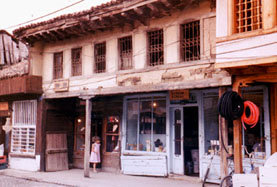
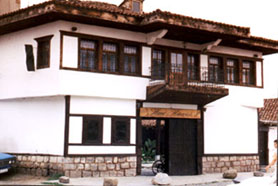
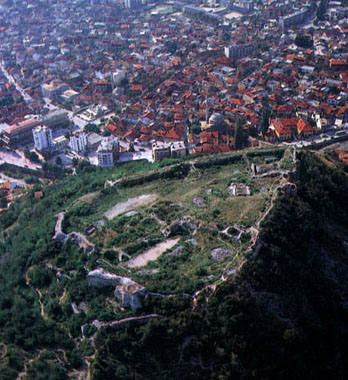
 Birthplace of both dictator Enver Hoxha and poet Ismail Kadare, this town is worth visiting for the sweeping views from its castle, and for the well-preserved Ottoman architecture of the merchants' houses, clinging against the mountain and built with defence purposes in mind.
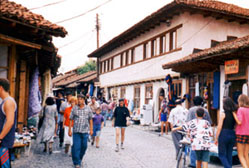
A World Heritage site, Gjirokastra also has a charming bazaar area with small shops facing cobbled streets. The castle, entered from either the valley or the town side, now houses the National Arms museum, though the best things about it are the fantastic views across the valley, and the desintegrating US Airforce jet plonked on top of the castle. When it landed in 1957, the regime claimed that the plane was spying on Albania and was forced down, though now it seems that the unlucky pilot simply got lost in bad weather and had to make an emergency landing.
For food, try the Festivali or the Argjiro restaurants just below the bazaar; the Fantazia bar on a hilltop above the bazaar has a great terrace for drinking, but dodgy food.
The Kalemi Hotel (Llagjia Palorto, tel. 084 637 24/068 2234373, drguak@yahoo.com; €35 per room) is the place of choice for many foreigners, though the nearby Kotoni Guesthouse (tel. 084 635 26/069 2366846, rooms €25-35) is a cheaper option with simple rooms, one in Ottoman style. Both hotels are found above the bazaar; turn left up the steep road past the mosque, and then right.
Berat
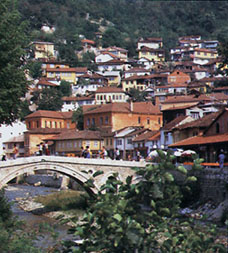
 The stunning museum town of Berat is a well-preserved Ottoman city (perhaps the best in the Balkans) with a lively lower town and a beautiful medieval citadel district on top of the hill. It's certainly worth staying longer to visit all the sights, and to go hiking on wild Mount Tomorri.
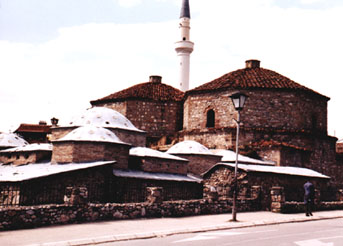
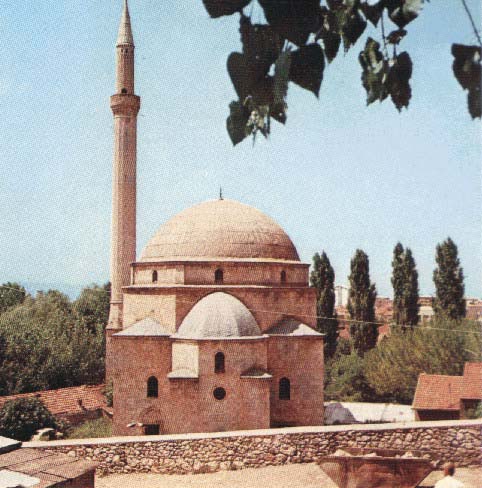
In the lower town, visit the Leaded Mosque, so named for the roofing material, the Bachelor's Mosque, the Sultan's Mosque and the Ottoman han (inn).
Berat's highlight is the inhabited citadel (100 lek, includes admission to the churches), reached via a very steep road (best drive up or take a taxi). Once inside the walls, you can visit ruined mosques and several medieval Orthodox churches, all intact and with restored frescoes and icons. The famous Onufri museum (open 09:00 - 16:00, www.beratmonument.org.al; 200 lek) is housed in a wonderful church and holds the best collection of Albanian icons anywhere, many painted by local artist master Onufri. There's a small shop and a café inside the citadel for buying drinks and snacks.
The German-Albanian Berati Tours agency (tel. 069 20 65 239, info@regio-berater.de, www.regio-berater.de) is the driving force behind attempts to convince local authorities to offer more tourist facilities. Contact them for information, accommodation bookings, tours of the town, spectacular guided hikes in the surroundings and more. Their Berat Discovery Weekend package is an excellent deal at €75, and includes lodging, meals, and tours of the city and a nearby gorge.
The luxury Residenca Desaret Hotel (Lagja 13 Shtatori, tel. 032 375 93; rooms from €50) offers great views of town. A cheaper option is the Berati Hotel (Lagja 28 Nentori, tel. 032 369 53, rooms €10-20), in a quiet alley off the main shopping street. A fun budget choice is the Mangalemi hotel (also know as the Tomi Hotel, Lagja Mangalem, tel. 032 320 93/068 24 29 803; rooms €10-20), a cheerful family-run inn with simple air-conditioned rooms, a relaxed rooftop terrace and an excellent restaurant for both eating and drinking. Alternative types can look up the relaxed Havana Bar, along the river behind the Tomori Hotel.
Enjoy the trip.
 Dhermiu is a Village located between high mountain and the
  Due to its location and warm weather Dhermiu is very attractive for tourists in Albanian Riviera.